

Jigsaw Puzzles, Temple, and a Roman Reservoir: Sham Shui Po Through Young Eyes

Yannie Wong, far right, pictured with primary school students among the granite piers and red brick arches of the reservoir, which recall Roman civil engineering. Other team members at the back, from left to right: Jasper Nip in black T-shirt, Lucy Chow in back T-shirt with a black mask, and Rachelle Wong.
When primary school students learn about the history and culture of their community, they build a stronger connection with the place where they live and study, and their sense of belonging to the city grows with it. Guided by this belief, eight students from the Bachelor of Social Sciences (Honours) in Sociology and Community Studies (BSocSc(SCS)) programme designed a series of community learning activities, held across four Wednesdays in April, for a primary school in Sham Shui Po. A final showcase of learning outcomes was held at the school on 9 and 10 May 2026.
Around 50 students from various year groups at Lingnan University Alumni Association (HK) Primary School (LUAAPS) took part in the one-month project, which aimed to deepen their knowledge of Sham Shui Po through interactive games, talks, community tours, and the production of a community newspaper. As a highlight of the programme, the BSocSc(SCS) students taught their primary school counterparts how to use the AEIOU observation framework and the 5-Ws-1-H checklist to observe more carefully during their visits across the district. They also applied the 5E learning cycle to reinforce key takeaways for the younger learners.

Iris Ku, a member of the Sham Shui Po capstone project team, pictured explaining the cultural, historical, and tourist significance of sites across Sham Shui Po to primary school students.

Primary school students put together a jigsaw puzzle of cultural and historical sites in Sham Shui Po at the first learning activity.
“Our students designed four educational activities for participants from the primary school. The first activity on 1 April was a camp where school students learnt about their community through a brief introduction to Sham Shui Po and a set of community games. At the second activity on 15 April, the BSocSc(SCS) students gave a talk covering the AEIOU observation framework, 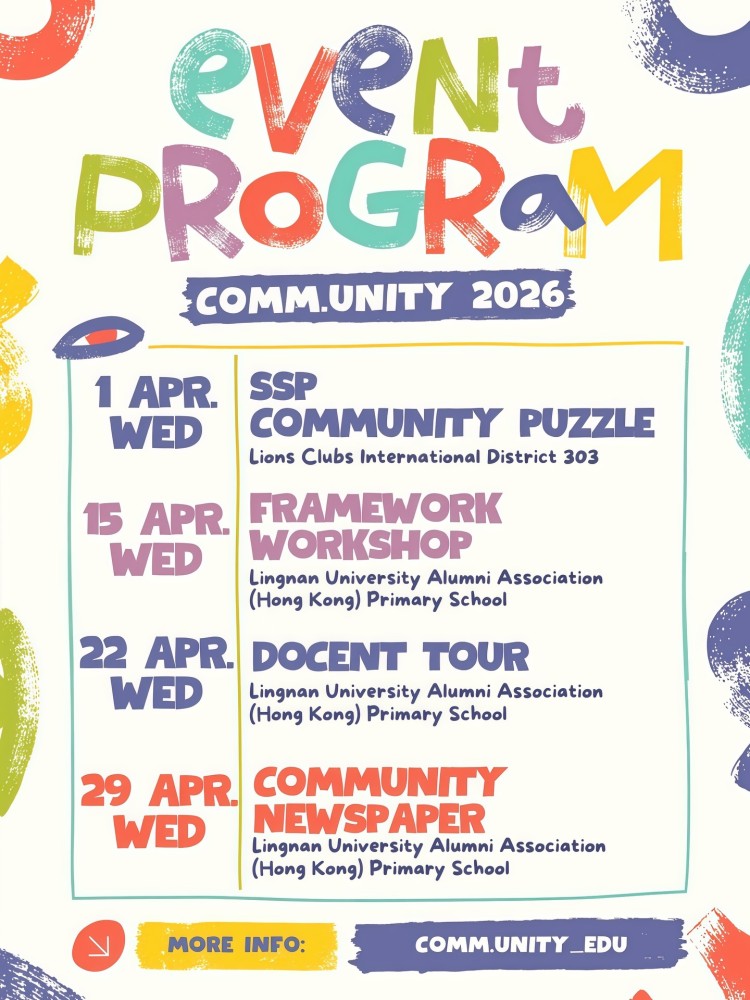 the 5E learning cycle, and the 5-Ws-1-H checklist. At the third on 22 April, primary schoolers, now equipped with these tools, were led by our students to visit Mei Ho House, the Sam Tai Tsz Temple, and the Ex-Sham Shui Po Service Reservoir in the school’s neighbourhood,”said Dr Kristy Yip So-king and Dr Veronica Zeng Wenxin from the Department of Social Sciences and Policy Studies (SSPS), who supervised the BSocSc(SCS) students in carrying out the project.
The AEIOU framework, an acronym for Activity, Environment, Interaction, Object, and User, is designed for documenting user behaviours and environments in real-world contexts. The 5E learning cycle, standing for Engage, Explore, Explain, Elaborate, and Evaluate, is an instructional model used to design inquiry-based lessons that encourage active learning and help students build understanding step by step through exploration and reflection. The 5-Ws-1-H checklist refers to questions about Who, What, Where, Why, When, and How, helping observers cover the key details of a situation and organise their findings systematically.

School students using the AEIOU framework to observe an old-fashioned barbershop, an exhibit at the Heritage of Mei Ho House (HMHH) museum.
During the community outing on 22 April, primary students first visited Mei Ho House, the sole surviving block of the demolished Shek Kip Mei estate, now preserved as a youth hostel and heritage museum. At this revitalised building, students were taken back to the 1950s—when the estate was built to house victims of a fire that destroyed the Shek Kip Mei squatter settlement. Students used the AEIOU framework and 5-Ws-1-H checklist to observe everyday life of that era. When guided to reflect on the narrow living spaces, shared bathrooms, and basic furnishings, they came face to face with the contrast between conditions then and what they take for granted today.
After visiting Mei Ho House, the primary schoolers split into two groups to continue their exploration. Lucy Chow Sin-tung and fellow BSocSc(SCS) students led one group to the Ex-Sham Shui Po Service Reservoir. Also known as the Bishop Hill Reservoir, this underground structure was built in 1904 to store water. “At this heritage site, known for its Romanesque architecture, we encouraged students from LUAAPS to observe the environment, the physical objects, and the interactions between people at the site,” Lucy said. On the walk to the reservoir, her groupmates explained to the students how urban development eventually made it obsolete, and how conservation work was later carried out to preserve it.

BSocSc(SCS) student Lucy Chow explains to the primary schoolers that the Sham Shui Po Service Reservoir once served as a key water storage facility supplying fresh water to residents of Kowloon Tong, Sham Shui Po, and Tai Hang Tung.
Iris Ku Tse-shuen led another group of eight primary schoolers to visit the Sam Tai Tsz Temple, built around a century ago to worship Na Cha (哪吒), also known as Sam Tai Tze, literally meaning “the third prince”. “They were guided to use the AEIOU and 5-Ws-1-H models to observe the temple. They found worshippers burning incense sticks inside, and they also made observations on the temple’s architecture and the objects on display, noticing wooden decorations, deity idols, incense burners, and fortune sticks,” Iris said.
As students of sociology and community studies, Iris and her teammates were conscious of encouraging the primary school students to think from a social perspective. “I prompted the students to think about who lived in estates like Mei Ho House decades ago and what challenges they faced. Walking towards the temple, we noticed that many South Asian people live in the neighbourhood. We used that observation to remind the students of the importance of respecting and living harmoniously with people from different ethnic backgrounds,” Iris added. Iris currently works as a part-time teaching assistant at a secondary school and said the Sham Shui Po project gave her the chance to practise her knowledge of designing learning activities in a school context.

A young visitor learns about historical sites in Sham Shui Po at a game corner during the mini-exhibition held at the school’s open day, 9–10 May 2026.

Lucy, left, and Yannie teach a young visitor how to play a card-drawing game, in which players describe what they observe from the card they draw to rediscover the often-overlooked features of the community.

At the exhibition, a visitor looks over findings from the Sham Shui Po community project.
To consolidate what the primary schoolers had learnt, the BSocSc(SCS) students guided them in the final session on 29 April to produce a community newsletter covering their classroom learning and on-site observations from the previous activities. Alongside organising the four learning activities, the BSocSc(SCS) students also hosted a mini-exhibition at the school’s open day on 9 and 10 May, presenting the outcomes of the community learning project. BSocSc(SCS) students who took the Sham Shui Po community work as their capstone project were Lucy Chow, Rachelle Wong, Jasper Nip, Iris Ku, Yannie Wong, Winsy Yao, Crystal Ling and Ethan Lee.
LUAAPS highly valued the effort of our students in designing and leading a range of activities. Through these activities, students from LUAAPS learnt and applied new methods to observe historical and cultural sites in Sham Shui Po.
“LUAAPS highly valued the effort of our students in designing and leading a range of activities. It further featured these programmes on the school Facebook as a recognition of BSocSc(SCS) students’ contributions. Through these activities, students from LUAAPS learnt and applied new methods to observe historical and cultural sites in Sham Shui Po. On our side, the eight students in the project team were excited to apply their classroom knowledge in practice, helping the primary schoolers build a stronger connection with their community. We will continue to ensure that such an integration of sociological knowledge with practical community engagement experience remains an integral part of the BSocSc(SCS) programme,” Dr Yip and Dr Zeng remarked.

Members of the Sham Shui Po community project picture with their teachers at the Chinese YMCA of Hong Kong- Lions-YMCA Junk Bay Youth Camp, where the first learning activity was carried out. From left to right, back row: Ethan Lee, Rachelle Wong, Lucy Chow, Iris Ku, Winsy Yao, Crystal Ling, Jasper Nip and project supervisor Dr Kristy Yip So-king. From left to right, front row: Dr Veronica Zeng Wenxin from the Department of Social Sciences and Policy Studies (SSPS), BSocSc(SCS) Programme Leader Dr Izzy Jian Yi, and Yannie Wong.
